Monday, October 29, 2012

How to eat a Triceratops:
Open It Like a Soda Can

I’ve always been fascinated by dinosaurs and other prehistoric creatures. If I hadn't become an entomologist, I would have been a vertebrate paleontologist in search dinosaur fossils. In a departure from my usual entomo-banter, I offer this recent article on Tyrannosaurus behavior.


Denver Fowler, of the Museum of the Rockies in Bozeman, Montana, presented research at the Society of Vertebrate Paleontology's meeting last week that suggests Tyrannosaurus fed on Triceratops by ripping their heads clean off.

By studying Tyrannosaur tooth marks on Triceratops specimens, Fowler and his co-authors found that Tyrannosaurs would regularly bite the Triceratops’ frills. Apparently, the bite marks weren’t from battles with other dinosaurs as none showed signs of healing, but, suggested they were from post-mortem carcass scavenging. Because the marks were determined to be consistent, the team posited an interesting hypothesis: Tyrannosaurus used Triceratops’ frills as a lever to rip their skulls from their body - like a tab on a soda can - to expose the dense and meaty neck muscles.


Further Reading

http://www.denverfowler.com/publications/Fowler_et_al_2012.htm

Derek Mead: http://motherboard.vice.com/2012/10/25/how-to-eat-a-triceratops-open-it-like-a-soda-can--2
Color image courtesy of same.
Drawing courtesy of Nate Carroll 2012.

© Delbert La Rue 2012. All Rights Reserved.

Friday, October 26, 2012

Remarks on the purported distribution of Polyphylla mescalerensis Young
in Chihuahua, Mexico.

Based on a series of 19 males, Young (1988) described Polyphylla mescalerensis from the Mescalero Sand Dunes, of southeast New Mexico. The unknown female, at that time, was described in my subsequent paper of 1998:28.

Polyphylla mescalerensis Young
Topotype Male
Heretofore, the species has been thought to be restricted to this particular dune system and other contiguous pockets of sandy refugia.

Partial view of Mescalero Sand Dunes with summer monsoon approaching.


View of Mescalero Sand Dunes, sand blowouts in distance.


On pages 24 and 26 of Young's monograph, where two versions of his key to North American species are presented (one including male aedeagal characters, the other not), he cites "Chihuahua, Mexico" in the concluding dichotomy for P. mescalerensis.

Scarab Guru, Richard Cunningham

Curiously, however, he made no further explanation nor justification for the Chihuahuan citation any where in the publication. I suspect his addendum may have been a last minute addition to either his manuscript, or most likely, the galley proofs.

In the decades since Young's publication, no reference,
that I am aware of, to this alleged distributional extension
has been formally discussed or verified, apparently, being
overlooked by subsequent authors including myself.

Through a series of fortuitous events, aided by the generous assistance from fellow scarab enthusiast and guru, Richard Cunningham, I acquired a purported specimen of P. mescalerensis labeled as ...

 "MEX: CHIHUAHUA, Cerro San Luis, VIII-13-81, 1767m at light, Scott McCleve" 

and bearing a "R.M. Young 1988" determination label. Of course, I have no idea what or how many specimens Young examined to warrant the distributional amendment of P. mescalerensis. However, considering the coincidental year of his determination label, 1988 (below, right), and publication of his monograph,  also 1988, I would venture to speculate this is probably one of them.

  Polyphylla sp. male
Chihuahua, Mexico

Labels of Polyphylla specimen from Chihuahua, Mexico.
D.A. La Rue collection


In my paper of 1998:32, I invalidated Young's distribution of Polyphylla monahansensis Hardy & Andrews from, yet again, Chihuahua, Mexico. My reasoning was that a desert sand dune obligate would not also occur in a montane environment ("large canyon bottom," Young 1988:52; 5,000-5,500 ft.elevation, La Rue 1998:32). Sand dune obligates have evolved physiological, morphological, and behavioral adaptations allowing them to exist in such environments (La Rue 1998). In addition, most dune-inhabiting species of Scarabaeidae are apparently unable to survive in other desert areas (Hardy and Andrews 1987).  


Purported distribution of Polyphylla mescalerensis (sensu Young 1988).
With that being said, ...

It appears that similar circumstances prevail in the case at hand. Given the striking disparity of ecological parameters between the Mescalero Sand Dunes and Cerro San Luis (cerro, Spanish, meaning "hill"), a montane environment at 1767 meters (5800 feet) elevation, the Chihuahuan record for P. mescalerensis is here considered dubia notitia.

Consequently, the taxonomic status of the Cerro San Luis specimen, for which this post is based, comes into question.

Salient morphological characters (presence of pronotal and elytral setae; eroded, discontinuous elytral vittae; southwestern distribution) clearly indicate that it is related to P. diffracta Casey. Though the aedeagus of the specimen is in view, many authors, including myself, have noted significant intra-, and interspecific variation of this character thus regarding them of no diagnostic value. In addition, because of phenotypic variation often seen in any population of Polyphylla, definitive taxonomic assessment of the specimen cannot be made based solely upon one male exemplar ("T.L. Casey syndrome"). The possibility that it may represent an undescribed taxon is a valid consideration. However, a series of both sexes of adults is required to substantiate that possibility with any certainty.  

                                                 Literature Cited and Internet Resources

Hardy, A. R., and F. G. Andrews. 1978. Studies in the Coleoptera of western sand dunes. I. Five new Polyphylla Harris. Pan-Pacific Entomologist 54(1):1-8.

La Rue, D. A. 1998. Notes on Polyphylla Harris with a description of a new species. (Coleoptera:Scarabaeidae:Melolonthinae). Insecta Mundi 12(1/2):23-37. 

Young, R. M. 1988. A monograph of the genus Polyphylla Harris in America, North of Mexico. Bulletin of the University of Nebraska State Museum 11(2): vi+115 pp.

Map image courtesy of Google Earth.

                                            © Delbert La Rue 2010. All Rights Reserved.

Friday, October 19, 2012

2. Quest for the Honey Mesquite Borer,
Megacyllene robusta Linsley and Chemsak

                               Collection notes.                                        
                                                                                                                UPDATED: Friday, October 19, 2012
Tues - Thurs, September 25-27, 2012. 7:00-9:30 pm
Locality #1. Cochise Co., Sulphur Springs Valley.
Upper Sonoran Mesquite/Grassland   4166 ft. elevation

(4) M. antennata - 1 male, 3 females
Remarks. Collected at 40w blacklight.
Apparently a common species in southeast Arizona where it is associated with dead Prosopis glandulosa (Honey Mesquite).

I have taken it as early as March, then sporadically through summer, into early fall. Although circumstantial, it seems to fly early in the evening.


Saturday, October 06, 2012. 6:00 pm
Locality #1. Cochise Co., Sulphur Springs Valley.
Upper Sonoran Mesquite/Grassland   4166 ft. elevation

(1) M. robusta - female
Remarks. Found at base of store front window/entrance. Specimen dead but still pliable.


Sunday, October 07, 2012.
Locality #1. Cochise Co., Sulphur Springs Valley.
Upper Sonoran Mesquite/Grassland   4166 ft. elevation

(3) M. robusta - 2 males, 1 female
Remarks. Beetles were found in two of five traps. Although evidence is circumstantial as to a bait preference, beetles were in traps baited with brown sugar/beer mix. Nothing in other traps baited with molasses/beer.

Two of the beetles were alive and active indicating they had flown that morning.

Also in the traps, Euphoria sepulchralis rufina (3), and Cotinus nitida (1, weird bluish color).

Monday, October 08, 2012. 2:30 pm
Locality #1. Cochise Co., Sulphur Springs Valley.
Upper Sonoran Mesquite/Grassland   4166 ft. elevation

(3) M. robusta - 1 male, 2 females
Remarks. Two females in brown sugar/beer trap. A third, male, flew in and alighted on a nearby Mesquite branch while I was filling the trap. Beetles were in, or near, same brown sugar/beer traps as on October 7th.

I moved one unproductive molasses trap, thus far anyway, closer to the more attractive brown sugar traps.

                     Also in the traps, Euphoria sepulchralis rufina (1).

Tuesday, October 09, 2012. 2:30 pm
Locality #1. Cochise Co., Sulphur Springs Valley.
Upper Sonoran Mesquite/Grassland   4166 ft. elevation

(4) M. robusta - 2 males, 2 females
Remarks. Beetles were in both brown sugar (3) and molasses (1) baited traps.

Also in a brown sugar trap, Euphoria sepulchralis rufina (1).

I ponder why one particular brown sugar/beer trap is the most productive, consistently attracting beetles?

Consider, it hangs on the south edge of a large stand of 10-14 foot mesquites and is exposed to full sun for most of the day - from early morning to late afternoon ( i.e., during peak hours of M. robusta activity). Is it possible that solar radiation heats the fermenting trap contents making them more aromatic and attractive? The other traps are, more or less, hung in filtered sunlight being placed within the mesquite canopy. Or, as Occam's Razor decrees: "All things being equal, the simplest solution tends to be the best one,"  ... the trap is fortuitously placed in a good location.

Thursday, October 11, 2012. 1:00 pm
Locality #2. Cochise Co., Sulphur Springs Valley.
Upper Sonoran Mesquite/Grassland   4185 ft. elevation

(20) M. robusta - will sort to gender upon curating.
Remarks. "I love the smell of fermenting brown sugar-beer in the morning.
It smells like ... victory."

I hadn't had an opportunity to check trap contents since their deployment on October 4. Three traps, still contained about an inch of bait mix.

Also in the traps, Megacyllene antennata (1), Euphoria sepulchralis rufina (3), Plionoma suturalis (4), Sphaenothecus bivittata (10), Chrysobothris octocola (3).

Friday, October 19, 2012. 1:00 pm
Locality #2. Cochise Co., Sulphur Springs Valley.
Upper Sonoran Mesquite/Grassland   4185 ft. elevation

( -- ) M. robusta
Remarks. Individual beetles and mating pairs were still active on smaller (± 2-6 inch diameter) limbs of Prosopis glandulosa. I had removed all the traps earlier in the week. This trip was for investigative purposes as I was hoping to document evidence of beetle emergence. I asked Fred Skillman, Longhorn Ranch, Dragoon Mountains, to join me.


(Above). Arrow indicates area of Propsopis limb where emergence holes were observed. There were several similar areas throughout this tree but these were the most convenient to photograph. I lack irrefutable evidence indicating that these are actual M. robusta emergence holes, however, adults were actively flying and crawling over this area while I was present.


(Left). Closeup of emergence holes (± 0.25 inch dia.) (arrows) that had just begun to exude sap indicating very recent emergence.

I cannot explain the other slight damage to this particular area.


(Below). Holes sealed by sap flow several days after beetle emergence.

Note diameter of limb.
                                                  © Delbert La Rue 2012. All Rights Reserved.

Tuesday, October 16, 2012

Field photos of the Honey Mesquite Borer,
Megacyllene robusta Linsley and Chemsak


Adults were active on the lower base and smaller limbs of Prosopis glandulosa. Of over 200 images taken, I felt these two were the best.


© Delbert La Rue 2012. All Rights Reserved.

Wednesday, October 10, 2012

The Inexplicable Mojo of Tiger Beetles.

mo - jo - noun.
1. A magic charm, talisman, or spell. 2. Magic power.

Comments on Curation.

With their long spindly legs and thread-like antennae, curating tiger beetles, particularly Cicindelini, can be the ultimate challenge of one's dexterity, eye sight, and patience. When cleaned (degreased), pinned and labeled properly, the intrinsic beauty of a schmitt box or museum drawer of tiger beetles can be impressive.


Regrettably, I have borne witness to many a tiger beetle collection spoiled by poor curation. Hence, the impetus for the present series of posts.

After month's of planning and waiting, you've finally reached that mecca of tiger beetles that has eluded you. You've only had a single specimen of an endemic species that occurs here that a colleague gave you - just to whet your hunter-gatherer instincts. The summer monsoon has just soaked the locality within the last day, the sun pounds down on you and the humidity is perfect - for tiger beetles, anyway.                                                            
                                                                       
So, let's begin right there in the field ...

I collect specimens straight into double-seal vials of 95% ethyl alcohol (isopropyl or 70% can also be used). Several vials will easily fit in a cargo pocket, safari vest or backpack. Thus, hundreds of specimens can travel safely being held in a liquid medium, and, if need be, stored until time permits to begin the degreasing process. I also use the same system when collecting New World Acmaeoderini (Buprestidae:Polycestinae).

Before storing, I insert a small piece of paper with basic locality data written in pencil into the vial. Other collection and locality details are jotted down in a field notebook for later reference.

To secure the vials while en route, I use a vial tray adapted to fit inside of a wooden cigar box ... 


A piece of opened-celled rubber foam (upholstery foam) fits between the vials and box lid minimizing any jarring or rattling during transport.

Okay then, ... so what is "degreasing" and why is it necessary?

Degreasing, as it applies to adult tiger beetles, is the process of removing internal lipids (body fats) by placing specimens in a series of cleansing "baths" using a solvent, for example, Ether or Hexane.

If not removed, over time, these internal body fats may leach out to the exterior surfaces of the pinned beetle resulting in a badly discolored specimen sometimes to the point of obscuring the beetle's vibrant colors and distinctive maculations (markings). The hair-like setae will become matted as well.

In a nutshell, here is my process using petroleum ether:

I have found that it may take up to three, rarely more, sometimes fewer, degreasing baths of 7 to 10 days each to clean specimens thoroughly. After that interval, the ether will gradually discolor from the removed lipids. At this point, the liquid needs to be replaced with fresh ether. Continue this process until the liquid remains clear after the 7 to 10 days. When the series of degreasing baths are completed, the specimens can remain in the vial awaiting pinning and labeling. If longer storage is anticipated, return the specimens to alcohol.

A colleague, using Hexane, informs me that his specimens are fully degreased in about 3 days. In a pinch, "white gas" (Coleman lantern fluid) can also be used. I experimented with it years ago but didn't care for the final results.


NOTE. When using any of these highly volatile solutions use common sense and safety precautions:

  • Store containers in a cool dark place. 
  • Always use in a well ventilated area.
  •  Keep out of reach of children - and some adults.

Next time, how to properly pin, set, and label your degreased specimens.

                                                 © Delbert La Rue 2012. All Rights Reserved.

Friday, September 28, 2012

Quest for the Honey Mesquite Borer,
Megacyllene robusta Linsley and Chemsak,
using Fermenting Bait Traps

Because of their distinctive elytral patterns in striking black and yellow ("aposematism") or muted earth tones ("crypsis"), species of the longhorned beetle genus Megacyllene Casey (Cerambycidae: Cerambycinae: Clytini) are popular with collectors.

In past Fall seasons, I have serendipitously encountered a few specimens of this beautiful species, Megacyllene robusta Linsley & Chemsak:

Megacyllene robusta
Linsley and Chemsak
Female
Admittedly, collecting longhorned beetles (Cerambycidae) isn't exactly my milieu. Yet, I challenged myself to make an effort to collect more of a series of this and other local Megacyllene this Fall. Hopefully, along the way, educating myself a little about their bionomics and distribution.

From my field notes of prior specimens (3), M. robusta adults were collected in late morning to early afternoon in late October. One locality, where three were found, is a service station surrounded by Mesquite/Grassland at 4166 feet elevation. One beetle was found on a sunny white wall and two others around the gas pump islands. Anecdotally, other species of Cerambycidae are known to be attracted to petroleum distillates. One that immediately comes to mind is the Banded Alder Borer, Rosalia funebris Motschulsky, which is commonly attracted to volatiles of freshly painted buildings and creosote-treated utility poles. Agreed, my inference that M. robusta may be similarly attracted is pure speculation.

In southeast Arizona, there are two other temporally and geographically sympatric species: M. antennata (White), and M. snowi snowi  (Casey).


Megacyllene antennata (White)
Female
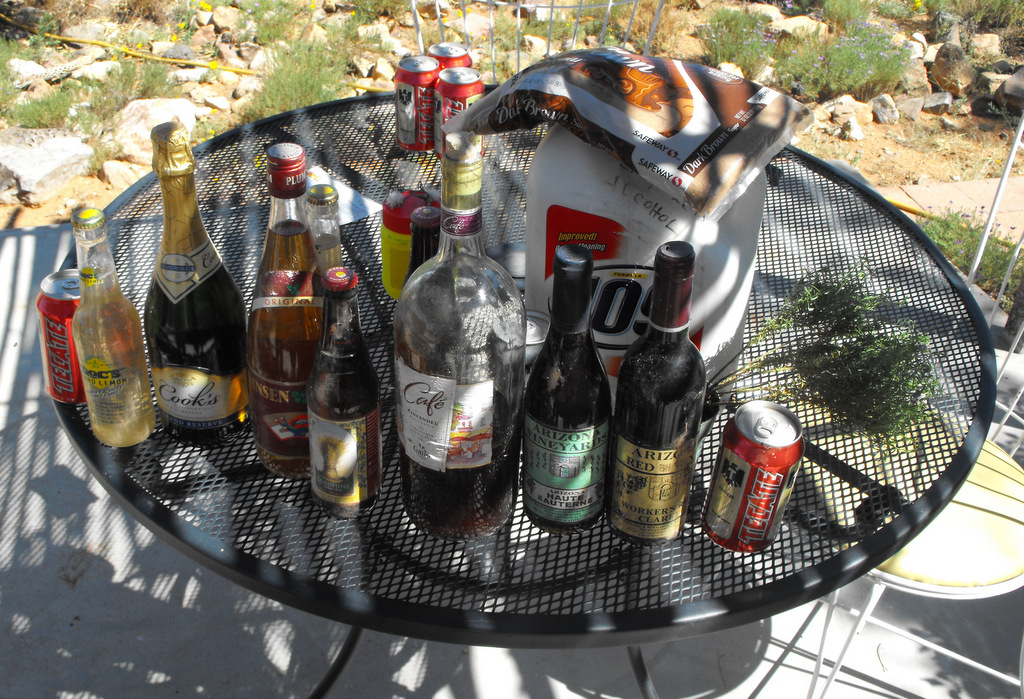
Fermenting bait traps have long been employed to collect a wide variety of beetles, especially scarabs and longhorns. Often they will attract species otherwise difficult to obtain. There are probably as many "bait" variations as there are insects attracted to them. A veritable cornucopia of ingredients, and combinations of, have been used including cheap wine, stale beer, vinegar, brown sugar, molasses, rotting fruit, and denatured alcohol. Essentially, the bait is poured into a plastic container, usually a 1-gallon juice or water jug, modified by cutting out large openings on the sides. Beetles, and other insects, attracted to the fermenting cocktail, enter the trap and drown in the liquid. (Above, my collection of raw "bait" materials).

Megacyllene snowi snowi (Casey)
Female.

For my efforts, I follow recipes and deployment tips suggested by colleagues, Missouri entomologist, Ted MacRae, author of the highly recommended Beetles in the Bush, and Cerambycid cognescenti, Fred Skillman, Longhorn Ranch, Dragoon Mountains, Arizona ...

Bring 12 oz. dark molasses or 1 lb. brown sugar and 12 oz. beer, wine, or similar libation up to 1 gal. with water. Add a packet of active dry baker’s yeast to get the fermentation process started and mix well.

For best results, hang the trap in a tree or suitable shrub along the edge of forest borders. Traps placed inside forests or stands of vegetation usually yield smaller amounts of beetles but possibly different species.

Add 1-quart of fresh liquid. Generally, it will take 2-3 days for the liquid to start fermenting and become attractive. It will remain so for about another week.

Check traps every 2-3 days by pouring the liquid bait through a fine kitchen strainer into another container. Reuse or replace the liquid as necessary. A can of beer or other alcoholic beverage can be used to replenish the liquid to a suitable level.

Collected specimens should be washed in water to remove bait residue.

Here then, are my trap localities in the Sulphur Springs Valley, Cochise County ...

Above. Locality 1. This is the locality mentioned above at 4166 feet elevation . The area has been slightly impacted by automobile and diesel traffic and light construction. The original expanse of mesquite has been curtailed to just a few acres. Five traps were placed here.

Below. Locality 2.  Upper Sonoran mesquite/grassland at 4185 feet elevation. The area is being utilized as open range. Three traps were placed here among many large stands of old growth mesquite.


NOTE: All sites are on private property. I have been granted permission to conduct my trapping activities by the property owners with the caveat that I keep specific locality information discreet.


Internet Resources
Megacyllene antennata, M. snowi snowi photos courtesy of  A Photographic Catalog of the  Cerambycidae of the New World 

© Delbert La Rue 2012. All Rights Reserved.

Sunday, September 23, 2012

Rainforests & Macro Photography:
Tips, Tricks, Techniques


Some of the finest photography of invertebrates, mammals, other related subjects, and breathtaking scenery is published in the adventure blog "Rainforests" by Paul Bertner.

Wednesday, September 19, 2012

Tigers in the Yard

I was pleasantly surprised to find several of these tiger beetles,

(Cicindela) Habroscelimorpha fulgoris erronea Vaurie,

around my patio light. It occurred to me that this was rather late in the season for them as this subspecies is common in July and August in response to the summer monsoon. In addition, there hasn't been any trace of rain in over two weeks, though, there are a few puddles from prior storms.

This subspecies is endemic to the Sulphur Springs Valley of southeast Arizona where it is associated with wet saline flats. It's coloration varies from bright green, blue or purple.

This voucher specimen documenting it's late temporal activity, I'm afraid, is a bit worse for wear ... and my poor photography doesn't do it justice.


Here is the series in my cabinet ...


© Delbert La Rue 2012. All Rights Reserved.

Wednesday, September 12, 2012

The Patron Saint of Tannu Tuva:
~ Richard Feynman ~
"The Pleasure of Finding Things Out"


Richard Phillips Feynman, (1918-1988), was an American theoretical physicist. For his contributions to the development of quantum electrodynamics, he jointly received the Nobel Prize in Physics in 1965. He participated in the Manhattan Project assisting in the development of the atomic bomb and was chosen as a member of the panel that investigated the Space Shuttle Challenger disaster of 1986. It was his investigations that singled out the effects of freezing temperatures upon the shuttle O-ring seals - which ultimately proved to be the colloquial "smoking gun."

His ability to articulate complex scientific principles and concepts in an informal, comprehensible style significantly inspired and impassioned my journey as a scientist, naturalist and entomologist and my quest to understand the veil of nature.

... watch, listen, laugh, and enjoy ... I laughed about the "word bag."


Duration: 40:39
"Nature uses only the longest threads to weave her patterns, so that each small piece of her fabric reveals the organization of the entire tapestry."
~ Richard Feynman, Transcript of the Messenger Lectures at Cornell University, presented in November 1964.

© Delbert La Rue 2012. All Rights Reserved.

Odds & Sods

My watercolor Moleskine and Lamy Safari 'Demonstrator' fountain pen with F-nib and blue-black ink.